AI Career Growth: Track Progress, Build Promotion Proof
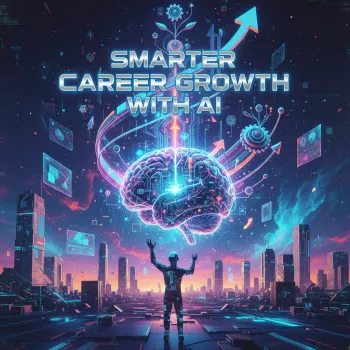
Smarter Career Growth with AI: A Digital Guide to Track Progress and Build a Stronger Future
Career momentum often stalls when goals are vague, feedback is scattered, and progress is hard to measure. AI can turn everyday work signals—projects, wins, learning, and feedback—into a clearer growth system that’s easier to maintain week to week. With the right guardrails, AI becomes a practical assistant for capturing evidence, shaping a stronger portfolio, and making career decisions with less guesswork and more proof.
What “smarter career growth” looks like with AI
Smarter growth isn’t about doing more tasks—it’s about building a measurable track record. AI helps convert messy work activity into clean outputs you can reuse for performance reviews, promotion packets, and interviews.
- Turn work output into measurable progress: outcomes, impact, and skills gained—not just tasks completed.
- Summarize weekly accomplishments into achievement statements ready for reviews or interviews.
- Spot patterns in what leads to recognition, stronger performance ratings, promotions, or better opportunities.
- Reduce decision fatigue by turning big goals into a simple weekly operating system.
Labor markets are shifting quickly, and skill change is accelerating across industries—keeping your evidence organized matters as much as building the skill itself. For broader context on how roles evolve, see the World Economic Forum’s Future of Jobs Report and role outlooks in the U.S. Bureau of Labor Statistics Occupational Outlook Handbook.
Set a clear direction: role targets, skill map, and milestones
A strong plan starts with clarity on “where” and “what proof”:
- Define a target role (or two) and the evidence required to be a confident hire or promotion candidate.
- Create a skill map: core skills, adjacent skills, and proof items (projects, metrics, artifacts, endorsements).
- Convert vague goals into milestones with timelines and “definition of done” criteria.
- Build a feedback loop: what to measure weekly vs. monthly vs. quarterly.
Career growth map built with AI (example)
| Element | What AI helps produce | What to collect |
|---|---|---|
| Target role | Role profile + required competencies | 5–10 job postings, internal role guidelines |
| Skill gaps | Gap analysis + learning plan | Current resume, projects, performance feedback |
| Milestones | 90-day plan + weekly actions | Calendar availability, constraints, priorities |
| Proof of impact | Achievement bullets + portfolio outline | Metrics, before/after results, artifacts |
| Support network | Mentor map + outreach drafts | List of leaders/peers, communities, events |
Track career progress using AI without overcomplicating it
The simplest sustainable system is a weekly log plus a monthly review. The goal is consistency, not perfection.
- Create a weekly “work log” and let AI turn it into: impact summary, blockers, and a next-week plan.
- Capture outcomes in a consistent format: problem → action → result → metric → lesson.
- Maintain a living brag document for performance reviews and promotion packets.
- Track measurable indicators: delivery, quality, leadership behaviors, communication, and learning velocity.
To keep it lightweight, aim for 10 minutes at the end of Friday (capture) and 20 minutes on Monday (plan). Over time, you’ll build a searchable evidence library that makes reviews and interviews dramatically faster to prepare.
Turn daily work into promotion-ready evidence
Promotions are often decided on demonstrated scope and impact—not effort. AI can help translate what you did into what it changed.
- Translate projects into outcomes that matter: revenue, cost, time saved, risk reduced, customer satisfaction.
- Draft performance review bullets aligned to your company’s competency framework.
- Build a portfolio (even for non-creative roles) with sanitized artifacts: plans, dashboards, retros, SOPs.
- Prepare a “promotion narrative”: scope growth, stakeholder impact, and leadership examples.
One practical tactic: for each major project, save a one-page “impact note” with the baseline, your intervention, and the measurable outcome. AI can then help you produce multiple versions: an executive summary, a resume bullet, and a STAR story for interviews.
Use AI for smarter learning and skill-building
Learning sticks when it’s tied to output. AI is most useful when it helps you apply skills quickly.
- Generate a learning path that matches the target role and your real schedule (micro-learning format).
- Convert training into retention with AI-generated quizzes, flashcards, and practice scenarios.
- Practice real situations: stakeholder updates, negotiation scripts, and difficult conversations.
- Scope a small “proof project” that demonstrates the skill fast, with clear deliverables.
If time is tight, prioritize skills that create visible leverage: stakeholder communication, project scoping, metrics, and decision-making. Those tend to show up directly in performance ratings and promotion conversations.
Career decisions: switching roles, negotiating, or staying put
AI can help structure career decisions so they’re less reactive and more evidence-based.
Practical guardrails: privacy, accuracy, and workplace policies
Digital guide: a simple weekly system to stay on track
Recommended digital guides (instant download)
- Smarter Career Growth with AI | Digital Guide for Professionals | Learn How to Use AI to Track Career Progress & Build a Smarter Future
- How to Use AI to Discover Your Personal Values — AI Guide to Unlock Your True Priorities, Self-Discovery eBook, and Personal Growth Checklist
- Coding with Confidence in the Age of AI – Ultimate Digital Guide for Developers | Learn Smart Coding with AI-Powered Platforms
FAQ
How can AI help track career progress week to week?
Use a simple weekly work log and let AI summarize it into impact statements, key metrics, blockers, and a prioritized plan for next week. Over time, those summaries become a living brag document and a milestone tracker for skills you’re building.
Is it safe to use AI for work-related career planning?
It can be safe if you avoid confidential details, anonymize sensitive examples, and follow your employer’s AI and data-handling policies. Always verify AI-generated claims and numbers before using them in reviews, negotiations, or applications.
What should be measured to show real career growth?
Track outcomes (metrics and results), scope (bigger problems and broader ownership), complexity, stakeholder influence, leadership behaviors, and reusable evidence artifacts like plans, dashboards, retros, and documented decisions.






Leave a comment