Mood Tracker Checklist: Track Feelings, Build Better Habits

Mood Tracker Magic: A Simple Checklist for Emotional Awareness, Better Habits, and Mental Clarity
Emotions can shift quickly, while patterns build quietly. A mood-tracking checklist makes it easier to notice what affects energy, focus, and well-being—without turning self-care into a complicated project. With a simple digital format (and optional AI support), mood tracking can help spotlight triggers, strengthen routines, and create steadier mindfulness in everyday life.
What a mood tracker checklist does (and what it doesn’t)
A good mood tracker checklist translates “I feel off” into a few concrete signals you can observe. Over time, those small check-ins become a practical map of what helps and what drains you.
- Turns vague feelings into trackable signals (sleep, stress, connection, movement, meals, screen time).
- Highlights patterns across days and weeks so changes feel less random.
- Supports emotional vocabulary: naming emotions can reduce overwhelm and increase clarity.
- Doesn’t diagnose mental health conditions or replace professional care.
- Works best with gentle consistency rather than perfect daily entries.
For a deeper foundation on present-moment awareness, the American Psychological Association’s mindfulness overview offers a helpful, research-informed starting point.
Getting started in 10 minutes with a digital checklist
Fast setup matters. When mood tracking is easy, it’s more likely to happen on normal days—not just the tough ones.
- Choose a tracking window: 7 days for a quick baseline or 30 days for stronger trend signals.
- Pick 3–5 “anchors” to log daily (mood level, main emotion, sleep quality, stress level, one habit).
- Add one line for context: “What mattered most today?” to capture the real driver.
- Decide a consistent time: end-of-day reflection or a midday check-in—keep it realistic.
- Set a low-friction rule: if time is short, log only mood + one reason.
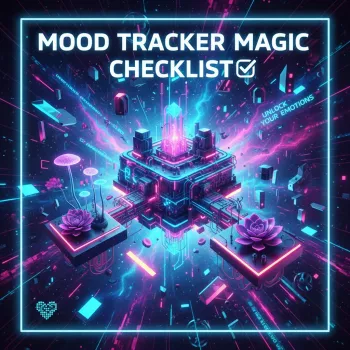
If a ready-to-use template helps you start faster, Mood Tracker Magic: Checklist (digital download) is designed for quick daily entries and simple weekly review.
A simple daily flow: check-in, note, choose one supportive action
The most effective mood trackers don’t just record feelings—they gently guide the next small step. Keep it tiny so it stays doable, even when motivation is low.
1) Check-in
- Rate mood (for example, 1–10).
- Select 1–2 emotions (calm, anxious, sad, energized, irritable, hopeful).
2) Note
- Capture one trigger or support: conflict, deadline, sunlight, workout, social time, solitude.
- Write one sentence: “What mattered most today?” (This often reveals the real cause.)
3) Choose one supportive action
- Pick one action that matches the mood: hydration, a 10-minute walk, tidy one surface, message a friend, guided breathing.
- Close the loop with one sentence of self-compassion: “What would help a friend right now?”
This approach keeps decisions small—because mood tracking works best when it leads to doable next steps rather than self-judgment.
Using AI to track mood without losing the human part
AI can be useful for organizing patterns, reflecting themes, and suggesting small experiments—but it shouldn’t replace your instincts or become the “authority” over your inner life.
- Use AI as a mirror, not an authority: it can summarize patterns and reflect your language back to you.
- Give AI structured inputs: paste your daily checklist entries once a week for a summary.
- Ask for pattern-spotting: “Which habits correlate with higher mood scores?” and “What recurring stressors appear?”
- Ask for gentle experiments: “Suggest 3 small changes to test next week, one at a time.”
- Protect privacy: remove names/identifiers, avoid sharing sensitive details, and store notes securely.
| Goal | Prompt to use | What to capture from the answer |
|---|---|---|
| Spot patterns | Summarize my week’s mood notes into 3 patterns and 3 likely triggers. Keep it non-judgmental. | Top patterns, top triggers, language that fits your experience |
| Find supportive habits | From these entries, list the habits that most often appear on higher-mood days. | 2–4 habits to keep consistent |
| Design a tiny experiment | Propose one 7-day experiment to improve my lowest-scoring time of day. Make it simple and measurable. | One action, when to do it, how to measure |
| Build emotional vocabulary | Suggest 6 emotion words that match my notes, with brief definitions and examples. | A shortlist of emotion labels to reuse |
If aligning daily choices with what matters most is part of your goal, How to Use AI to Discover Your Personal Values (guide + checklist) pairs well with mood tracking—values often explain why certain days feel “off,” even when nothing obvious happened.
Turning insights into better habits (without burnout)
The point of tracking is not to optimize every moment—it’s to learn what reliably supports you and what repeatedly drains you, then make changes that you can maintain.
When to pause and seek extra support
For additional context on symptoms and treatment pathways, the National Institute of Mental Health’s depression resource is a reliable reference point.
Digital download checklist: simple setup and use
To get started today with a streamlined layout, Mood Tracker Magic: Checklist | Digital Download for Emotional Awareness offers a simple daily flow plus space for weekly reflection.
FAQ
How often should mood be tracked for it to be useful?
Daily is ideal, but 3–4 times per week can still reveal patterns if you keep the same few “anchors” each time. Try a 7-day baseline first, then do quick weekly reviews to spot trends without overthinking.
Can AI accurately track mood from notes?
AI can summarize themes, highlight repeated stressors, and suggest small experiments, but it can’t measure emotions directly or diagnose anything. It works best with structured entries and privacy steps like removing names and sensitive details.
What should be included in a mood tracker besides mood rating?
Include a few common drivers such as sleep quality, stress level, movement, nutrition, social connection, health or cycle factors, and major events. Choosing 3–5 anchors keeps the tracker consistent enough to show patterns without becoming a burden.




Leave a comment